
Skin Regeneration
Dr Jason Brown
Dr Amanda Kjas
Dr Jason Brown (Metro North), in collaboration with Dr Amanda Kjas (UQ), is advancing biofabrication-enabled skin regeneration strategies for burns and complex wounds. This work targets improved healing, reduced complications and better long-term functional outcomes.
Clinical challenge
Current treatments, including skin grafts and dermal substitutes, often fail to fully restore normal skin structure and function due to poor vascularisation, infection risk and variable long- term outcomes. These limitations contribute to ongoing morbidity, scarring, functional impairment, and high health system costs, highlighting the need for more effective regenerative approaches.
Clinical application
Advancing clinically relevant skin regeneration strategies through biofabrication to address severe burns, with the goal of improving healing and long-term functional recovery. Grounded in clinically embedded research, the program integrates advanced skin models, biomaterials, and translational burns care. This work is supported by high-impact clinical research, including the development of biodegradable matrices and the application of 3D-scanned technologies for scar management and patient-specific interventions.
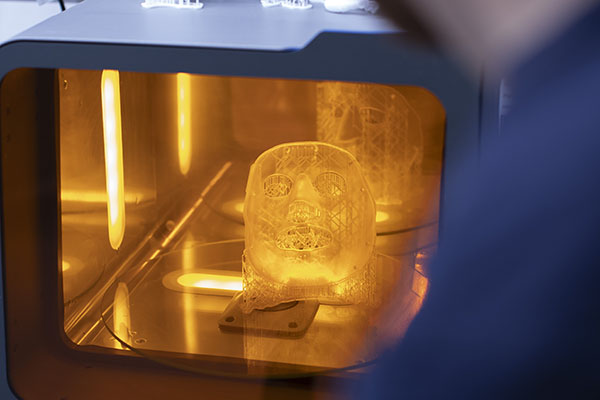
A transparent orthosis being UV cured after SLA printing.
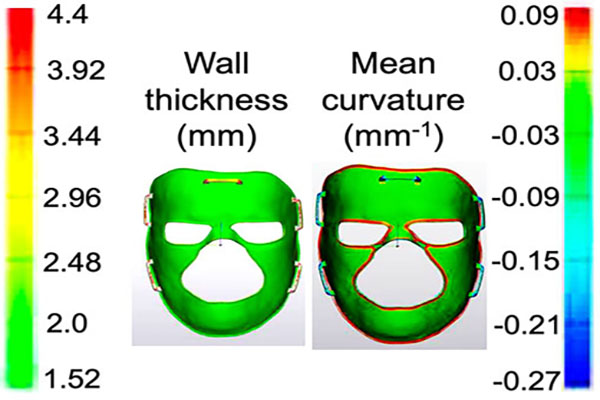
Surface deviation map of the internal surface of a transparent orthosis.
Impact
The impact of this research lies in its progression toward clinically deployable solutions that better replicate natural skin function. By connecting laboratory innovation with real-world burns care, the program is strengthening Queensland’s capability in skin biofabrication, regenerative medicine and trauma care. It also contributes to improved clinical pathways that aim to enhance healing outcomes, reduce complications and support long- term recovery for patients withcomplex skin injuries.
Publications
- Mostina M, Sun J, Sim SL, et al. Coordinated Development of Immune Cell Populations in Vascularized Skin Organoids from Human Induced Pluripotent Stem Cells. Advanced healthcare materials 2025;14:e02108.
- Ahmed I, Sun J, Brown J, Khosrotehrani K, Shafiee A. An optimized protocol for generating appendage-bearing skin organoids from human-induced pluripotent stem cells. Biol Methods Protoc 2024;9:bpae019.
- Shafiee A, Sun J, Ahmed IA, et al. Development of Physiologically Relevant Skin Organoids from Human Induced Pluripotent Stem Cells. Small 2024;20:e2304879.
- Sun J, Ahmed I, Brown J, Khosrotehrani K, Shafiee A. The empowering influence of air-liquid interface culture on skin organoid hair follicle development. Burns Trauma 2025;13:tkae070.
- Hosseini M, Brown J, Shafiee A. Strategies to Induce Blood Vessel Ingrowth into Skin Grafts and Tissue-Engineered Substitutes. Tissue Eng Part C Methods 2022;28:113-26.
- Betar N, Donovan M, Tyack Z, et al. Recovery in patients undergoing ablative fractional carbon dioxide laser for adult hypertrophic burn scars: A longitudinal cohort study. Burns 2025;51:107300.
- Betar N, Maher D, Wheatley L, Barker T, Brown J. Clinical outcomes and resource utilisation in patients with major burns treated with NovoSorb(R) BTM. Burns 2023;49:1663-9.
- Lo CH, Brown JN, Dantzer EJG, et al. Wound healing and dermal regeneration in severe burn patients treated with NovoSorb(R) Biodegradable Temporising Matrix: A prospective clinical study. Burns 2022;48:529-38.
- Kittrick AM, Brown J. 110 Implementation of 3D Technology for Management of Facial Scars Across the Spectrum of Care. Journal of Burn Care & Research 2025;46:S87-S.
As a burns survivor and consumer advocate, I strongly support investment in skin biofabrication research. Healing doesn’t end when the wound closes: many of us live with lifelong scarring, limited mobility, and ongoing surgeries. Biofabrication that can regenerate skin closer to natural human tissue offers real hope for better long‑term recovery.
Metro North Health, Herston Biofabrication Institute (HBI)
Level 12, Block 7
Royal Brisbane and Women’s Hospital
HERSTON QLD 4029
For General Requests: hbi@health.qld.gov.au
For Clinical Trials: hbiclinicaltrials@health.qld.gov.au