
Voice Clinic Evaluation
What is a nasendoscopy?
This procedure will provide your treating team with better insight into the inner workings of your larynx (voice box). The tool used for this procedure is called a nasendoscope, a thin, flexible tube with a light and camera attached to it. It will be passed through your nose to view and record different structures of your throat.
(Speech Pathologist speaking to camera)
SPEECH PATHOLOGIST: This video will cover the voice clinic procedure known as stroboscopy. During the video, we’ll cover the reasons why we do the procedure, how it’s performed, how it feels for the patient, as well as some of the risks and benefits.
(Ear, Nose and Throat (ENT) Surgeon speaking to camera)
ENT SURGEON: A nasendoscopy and stroboscopy is a really valuable way for a specialist to clearly view the structures of your nose, throat, and voice box. It also allows the specialist to test the function and movement of the voice box and the vocal folds.
(ENT Surgeon and Speech Pathologist speaking to a patient in a consultation room)
ENT SURGEON: Tell us about the issues that you’re having with your voice.
PATIENT: So I’ve had it for about two years.
SPEECH PATHOLOGIST VOICE OVER: At The beginning of the session, we’ll begin by taking a case history. Here you’ll be asked about your voice, lifestyle factors, occupation, past medical history, and current medications. At this time, the speech pathologist may also conduct a perceptual assessment of your voice.
PATIENT: And I noticed it after, like a couple months after that it just got progressively worse.
(Patient is sitting in a clinic chair. The Ear, Nose and Throat Surgeon carries out the procedure)
ENT SURGEON: We will use a local aneasthetic spray up your nose, which might take a few minutes to take effect. You’ll feel that sort of spray running down the back of your throat.
ENT SURGEON VOICE OVER: While the numbing spray is setting in the ENT will take a look inside your mouth and palpate your neck. The procedure uses a flexible nasendoscope tool. It’s a narrow tube with a light and camera attached, which we pass through your nose to both view and record the different parts of your throat.
The extra piece of equipment we have here is what’s called a stroboscopy, and during that procedure we shine light at your vocal cords to see the movement of the mucosal wave across the cords, which gives us extra information beyond what might just be seen with a normal nasendoscope.
During the procedure, we’ll ask you to perform a number of voicing tasks, things like taking a deep breath, making sounds of different pitch and loudness levels, and repeating certain sentences.
ENT SURGEON: I want you to say E for me.
PATIENT: eeee.
ENT SURGEON: Good. And say he, he, he.
PATIENT: he, he, he.
ENT SURGEON: Right. Now I want you to sniff an E, So E.
PATIENT: (sniffs) e, (sniffs) e.
SPEECH PATHOLOGIST: Saying these sounds now. e, e, e.
PATIENT: e, e, e.
SPEECH PATHOLOGISt: All the way over there.
PATIENT: All the way over there.
SPEECH PATHOLOGIST: Okay. If you can give us a long eeee at your comfortable pitch.
PATIENT: eeeee.
SPEECH PATHOLOGIST: Good. Show me now at a pitch glide.
PATIENT: eeee.
SPEECH PATHOLOGIST: Good.
SPEECH PATHOLOGIST VOICE OVER: At the end of the voice clinic, the ENT and speech pathologist will discuss your diagnosis with you and possible treatment recommendations.
(ENT Surgeon speaking to camera)
ENT SURGEON: The nasendoscope itself probably only takes about fiveto 10 minutes, but all up your appointment would be for about 30 minutes. Nasendoscope is really a very low risk procedure. Occasionally you can get a bit of bleeding from the nose may happen, but it usually stops pretty quickly. The risk of infection is very, very small, almost minuscule because the flexible nasendoscope tool is sterilized after each session. No food or drink is recommended for about 20 minutes after the procedure because we use a numbing spray, which can make it a little bit harder to swallow, and it’s best to make sure that you can feel the back of your throat before you have anything further to eat and drink.
(Patient facing camera. Speech Pathologist asking questions off-camera)
SPEECH PATHOLOGIST: Was the procedure painful?
PATIENT: Not at all. There was no pain.
SPEECH PATHOLOGIST: What did it feel like as it went through the nose?
PATIENT: You can’t really feel it that much. I think once it gets to the back, you can feel a little twinge and you don’t feel anything else after that.
What is the purpose of this procedure?
Your treating team has recommended this procedure to:
- Assess the health and function of the structures of larynx and vocal cords.
- Identify other middle airway and vocal cord conditions causing symptoms such as hoarseness, sore throat, tightness, breathiness, chronic cough, increased vocal effort, reduced range and pitch.
How the voice works
The larynx, or “voice box”, is made up of two vocal cords. They come together and vibrate to produce voice.
To speak clearly and loudly, the muscles of the voice box move the cords.
When you breathe, the cords move apart. When you speak, they move close together.
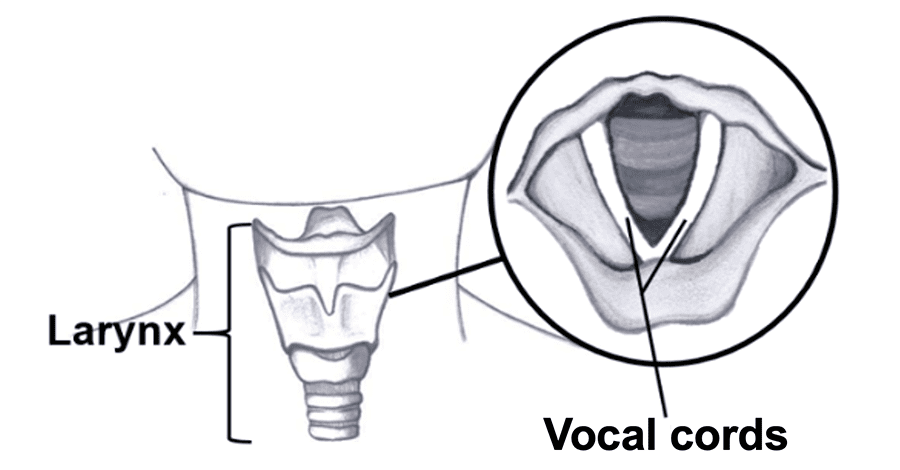
Figure 1 – Normal vocal cords
In patients with a voice disorder, vocal cord vibration may be changed due to:
- Growths on or around the vocal cords
- Neurological disorders (e.g. Parkinson’s, Spasmodic Dysphonia)
- The way your voice is produced (e.g. excessive use of muscles in your throat)
- Lifestyle factors (e.g. smoking, reflux)
Who Performs this procedure?
There may be an Ear Nose and Throat (ENT) doctor and/or a Speech Pathologist at the clinic.
- ENT doctors are specialists in medical and surgical management of voice box disorders.
- Speech Pathologists specialise in the treatment of voice disorders.
Before the procedure
- No special preparations are required for this procedure.
- You can eat, drink, and take medication as normal.
- You can drive before and after the procedure.
- In some cases, you may be asked to complete a questionnaire about your symptoms and medical history.
During the pocedure
- You will be awake and seated in a chair.
- A local anaesthetic spray is often used to numb the nose and back of the throat before the nasendoscope is inserted. This well help reduce any discomfort.
- The local anaesthetic spray may make your throat feel ’thick’ and swallowing might feel a bit different. This is due to the decreased sensation and will last for around 20 minutes.
- A narrow flexible tube (nasendoscope) will then be passed through your nose to the back of your throat.
- Once the nasendoscope is in place, your voice box will be observed at rest.
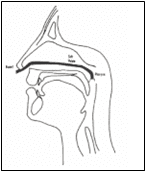
- You will be asked to perform certain tasks, such as:
- Taking a deep breath
- Making sounds at different pitch and loudness levels
- Repeating sentences
- During these tasks, the Speech Pathologist and ENT will be assessing how the vocal cords look and how they are moving.
- The clinic appointment will take approximately 30 minutes.
- The procedure itself can range from 5-10 minutes.

What to expect?
Generally, this is a very low-risk procedure. You may experience:
- Some pressure through the nose when the tube is inserted.
- The urge to sneeze, cough, or swallow during the procedure.
- Altered throat sensation for a short while after the procedure
In rare cases:
- Nosebleeds can happen, but usually stop very quickly.
It is recommended you do not eat or drink for approximately 20 minutes after the procedure.
What are the next steps?
You will review the video images with the ENT and Speech Pathologist and discuss diagnosis and options for management. This may involve:
- Voice therapy with a speech pathologist.
- Medications and behaviour changes.
- Surgery with the ENT +/- voice therapy after surgery.
- Watching and waiting.
- Referral to other medical specialists for further investigations.
Brochure
Download a brochure on this procedure.
Contact us
Speech Pathology and Audiology Department
Location: Level 2, Dr James Mayne Building, RBWH, Butterfield St, Herston, QLD 4029
Phone: (07) 3646 8026
Email: RBWH-Speech-Pathology
Open: 8.30am-4.30pm
Need help outside hours?
For non-urgent medical issues call 13HEALTH (13 43 25 84) or visit your GP.
In the an emergency call Triple Zero (000).
Resources
Pre-operation laryngectomy information for patients
Learn more about the swallow assessment you will be having
FEES – fibreoptic endoscopic swallow study – patient education video
VFSS – video fluoroscopy swallow assessment – patient education video