
Roze’s aspiration journey will help diagnose other kids with swallowing trouble
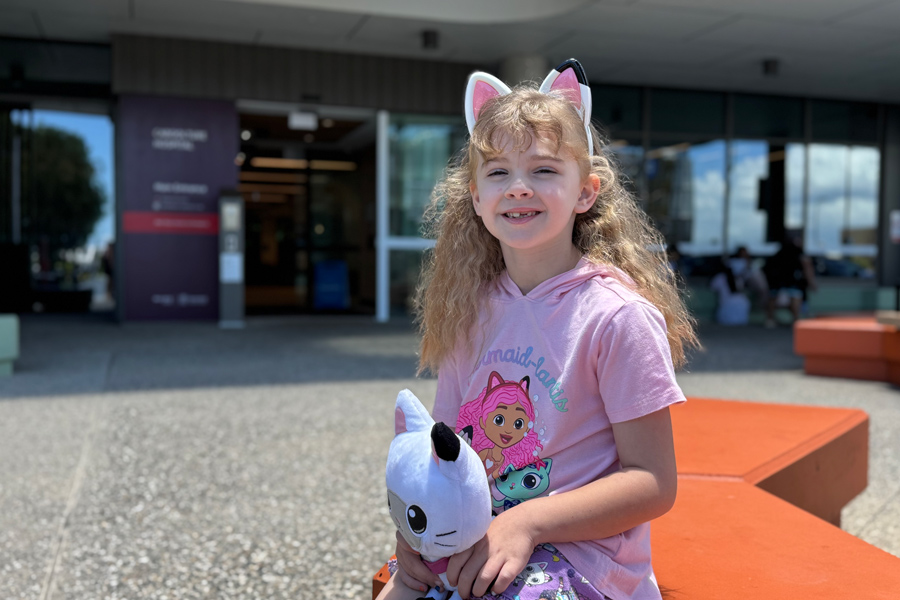
Roze is hopeful to enjoy simple childhood pleasures without constant risk of aspriation.
When Roze was born via planned caesarean section at Caboolture Hospital in 2019, mum Emma Clarke never imagined that she would spend much of her young life managing a complex aspiration condition caused by a minor laryngeal cleft.
Now six years old, Roze experienced ongoing respiratory and feeding difficulties from infancy, with years of illness, fatigue and repeated infections.
Following investigations, her treating team identified a deep interarytenoid groove, also known as a minor laryngeal cleft. The condition caused her to breathe food and drink into her airway when swallowing, which can lead to serious short and long-term lung disease in children.
“I had heard of aspiration before as I have family and friends who have had issues, but I didn’t realise the extent of what they went through,” Emma said.
Throughout her journey, Roze has been supported by a multidisciplinary team at Caboolture Hospital, including countless x-ray swallow appointments to diagnose and determine if there had been any improvements.
As a result of support received from the Caboolture Hospital Speech Pathology team, Roze’s health has improved significantly, and she now follows strict feeding and drinking guidelines under the care of feeding speech pathologists to help make her life as normal as possible.
“Roze’s sleep has stabilised, with most nights now uninterrupted, and her overall energy levels have increased,” Emma said.
Through her care journey with aspiration, Roze and her mum were introduced to a research project led by Adjunct Associate Professor Thuy Frakking, looking to better understand caregiver needs in the assessment of aspiration.
Emma’s contribution to the study through her first-hand experience will be used to guide the development of a digital app to help diagnose swallowing impairment and aspiration in children during routine mealtime observations.
“Current assessments, such as an x-ray swallow for aspiration are limited by reduced availability and involve the use of radiation,” Adj Assoc Prof Thuy Frakking said.
Adj Assoc Prof Frakking has dedicated time to exploring how swallowing sounds collected as part of her PhD research could be adapted with machine learning techniques to accurately diagnose swallowing impairment and aspiration.
“The development of an accurate algorithm to classify aspiration in children will help progress to the development of an app that families and clinicians can access worldwide without the need for x-ray swallows,” she said.
Now six, Roze is continuing to grow stronger and hopes she will one day return to swimming without the risk of aspiration.