
RBWH brings cardiac service closer to home
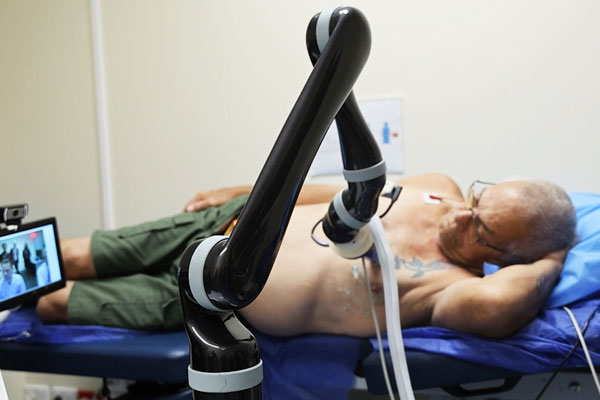
Patient receiving echocardiogram from robotic arm technology
Queenslanders living in remote and rural areas can now access specialist cardiac imaging closer to home, thanks to a pioneering tele-echocardiography service led by the Royal Brisbane and Women’s Hospital (RBWH).
The service enables an experienced sonographer at RBWH to operate a robotic arm located at the remote site, guiding the ultrasound probe on the patient’s chest while simultaneously controlling the ultrasound machine and interpreting the images in real-time.
RBWH Cardiac Scientist Cathy West said the service was transforming access to timely high-quality cardiac care for patients who would otherwise need to travel long distances.
“This technology allows sonographers at RBWH to perform detailed echocardiograms for patients hundreds of kilometres away, without the patient leaving their community,” Cathy said.
Local nursing teams play a vital role in the success of the program, preparing patients for their examinations, providing support during the procedure, taking observations, and ensuring the clinic runs smoothly.
“It’s important to emphasise that the sonographer is performing the examination—the robotic arm is simply the tool that allows their expertise to be delivered remotely. This ensures the same high clinical standards as a face-to-face scan,” Cathy said.
Longreach resident Gordon Jones is one of more than 60 patients who have benefited from the service, previously travelling almost 700 kilometres to Rockhampton for treatment.
“Now, I’m able to access the same service as someone in the city, without leaving the town where I’ve lived for more than 50 years,” Gordon said.
“With local staff around me and being able to see and talk to the sonographers in Brisbane, I still felt like I was receiving healthcare personalised for me.”
Cathy says that rural and remote communities in Queensland experience around 25 per cent higher morbidity and mortality compared to metropolitan areas, partly due to reduced access to diagnostic investigations.
“Earlier diagnosis means faster treatment, better outcomes, and stronger integration with existing telehealth cardiology services.”
“This model has enormous potential to be scaled across Queensland, including into Aboriginal and Torres Strait Islander communities where conditions such as rheumatic heart disease require early and regular assessment, delivered in-country wherever possible,” Cathy said.
The RBWH tele-echocardiography program represents a major step forward in delivering equitable, high-quality cardiac care to Queenslanders, regardless of where they live.