
RBWH becomes first public facility in Australia to offer NanoKnife treatment for prostate cancer
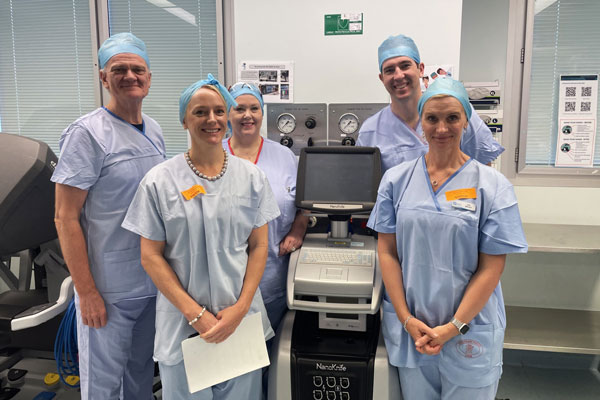
The RBWH Nanoknife team with the Nanoknife machine
Patients who develop recurrent prostate cancer now have access to a leading-edge procedure which minimises adverse outcomes typically associated with radiotherapy treatment.
The Royal Brisbane and Women’s Hospital (RBWH) is Australia’s first and only publicly funded facility to offer the NanoKnife procedure for patients who develop recurrent cancer in the prostate despite previous prostate radiotherapy.
The NanoKnife procedure is a minimally invasive treatment option, providing a welcome alternative to major prostate cancer surgery or salvage radiation therapy, and successfully removing cancer in the treatment area in more than 90 per cent of patients.
NanoKnife needles are inserted into the prostate around the site of the cancer and delivering electrical pulses. This punches holes in the cancer cell wall membrane, which cannot be repaired, and the cancer cell dies.
Previously, the prostate NanoKnife procedure was only available through the private system and is very expensive, making it out of reach for many Australians.
RBWH Senior Visiting Urological Surgeon Associate Professor John Yaxley said the ability to offer this treatment option in the public sector is a game changer in minimising adverse patient outcomes for local control of recurrent prostate cancer after prior prostate radiotherapy.
“After seeing the success of the procedure in the private sector, I wanted this technology to be available to public patients who otherwise may not be able to afford the treatment,” Dr Yaxley said.
“The NanoKnife procedure provides a significantly reduced risk of urinary incontinence, impotence, intraoperative and peri-operative complications, with minimal post-procedure pain and a rapid return to daily life compared to the alternative treatment option, salvage radical prostatectomy (prostate removal).
“Salvage radical prostatectomy and additional salvage prostate radiotherapy can result in severe negative quality of life outcomes for patients including bowel injury, urethral stricture, a 33-88 per cent risk of severe incontinence of urine and radiation toxicity to bowel and bladder.
“We know that just 0-15 per cent of men are sexually active after prostate removal following previous prostate radiotherapy and have only a 35 per cent chance of being free of progressive or recurrent cancer at 10 years.
“In comparison, an Australian trial of salvage NanoKnife treatment conducted by Professor Stricker in Sydney (FIRE Trial) confirmed that salvage NanoKnife treatment has similar results with 60 per cent of men free of further treatment at five years, and the benefit of significantly less risk and side effects.”
The NanoKnife procedure for prostate cancer also provides a favourable alternative to the more conservative treatment approach, androgen deprivation therapy (ADT).
“ADT comes with a range of side effects including impotence, hot flushes, weight gain, an increased risk of cardiovascular events and osteoporosis,” Dr Yaxley said.
“The cancer will always eventually progress despite ADT, as the cancer cell works out another way to grow without needing testosterone.
“The NanoKnife is a revolutionary treatment option for prostate cancer and I am thrilled we are now able to offer it at RBWH to suitable patients.”
Patient story
Clayfield resident and avid sailor, 77-year-old Robert Parkin was one of the first patients to receive the NanoKnife treatment at RBWH.
“I first began to experience health complications in 2012 and was diagnosed with a very minor prostate cancer that didn’t really develop,” Robert said.
In 2024, Robert’s treating team noticed some changes in his cells despite prior prostate radiotherapy. Robert was eligible for the NanoKnife procedure, which he had in January 2025.
“I had almost no pain at all from the procedure and was back home the next day,” he said.
“The alternative for me would have been to have my prostate removed. I’ve had friends who’ve had this done and it seems like quite a long and brutal recovery. It changes you physically and it’s a shame to do that to a man if it can be avoided.
“The fact that the procedure is now covered in the public system is a great thing. My cancer cells never had the chance to develop thanks to the NanoKnife.”