
Caboolture Hospital physiotherapist awarded for menopause research
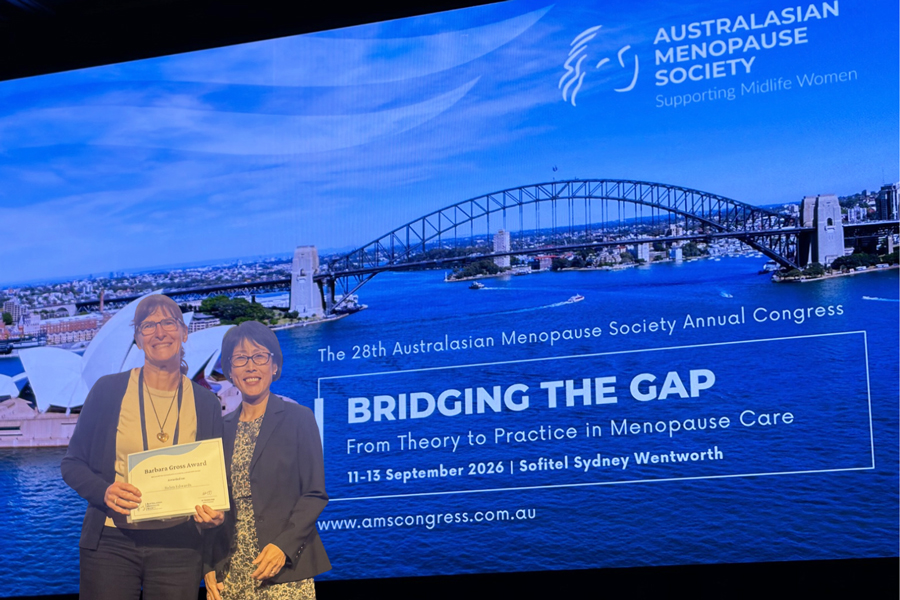
Caboolture Hospital physiotherapist Helen Edwards receiving the Barbara Gross Award at the Australian Menopause Society Congress in Sydney.
Caboolture Hospital physiotherapist Helen Edwards recently won an award for her research exploring the experience of menopause for staff working in healthcare. Helen received the Barbara Gross Award for best overall free paper or poster presented at the Australian Menopause Society Congress in Sydney in September, where she presented the first of three phases of her research.
What prompted Helen’s research was her more than 25 years working as a pelvic health physiotherapist at Caboolture Hospital. She saw the challenges women experiencing menopause needed to manage at work, particularly less talked about symptoms like bladder urgency or incontinence.
“…I wanted to see if there was a better way to support staff during menopause transition, particularly for healthcare workers, where our work often involves supporting others,” Helen said.
Another observation that drove Helen’s research was the lack of awareness women have about the whole range of menopause symptoms—aside from the usual hot flushes and sweats—like musculoskeletal pain, increased anxiety and/or bladder urgency.
“Everyone’s experience of menopause is individual… there is a whole variety of symptoms though that you may not have thought about,” Helen said.
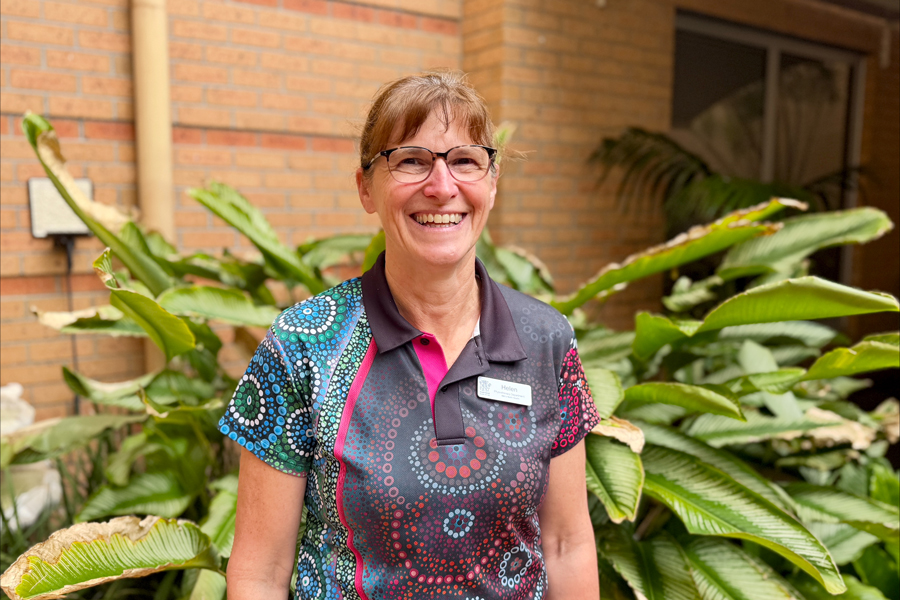
Caboolture Hospital physiotherapist Helen Edwards.
“If you’ve got hot flushes, because people know about hot flushes, you might be able to say to your boss, ‘Yes, I’m just struggling with hot flushes.’ If your symptom is, ‘I have to race to the toilet…I cannot wait’ that’s a lot more difficult for you to broach.”
Helen’s research involved surveying all Caboolture Hospital, Kilcoy Hospital and Woodford Correctional Health Service (CKW) staff to uncover their understanding, attitude and culture around menopause and—for peri- and post-menopausal staff—how prevalent and severe menopause-related symptoms are, and whether they are perceived to impact work performance.
“Our project identified that menopause-related symptoms are common and bothersome in the workplace to varying degrees, for the majority of peri- and post-menopausal staff at CKW,” Helen said.
“Only 1 in 10 peri- or post-menopausal staff feel women experiencing menopause-related symptoms are supported in the workplace.”
Countries like the United Kingdom and Ireland have done a lot of work to support staff during menopause transition in the workplace. However, there is a lack of research on workplace interventions generally, and if workplace interventions are effective. Helen’s next research phases—involving focus groups and workshops—are a codesign process involving staff with lived experience of menopause and other staff and healthcare consumers working together with the research team with to prototype what solutions should look like to support healthcare staff working through menopause transition.
“People often think: ‘Well, there’s nothing you can do about it; you’ve just got to put up with it.’ Whereas, in actual fact, we’ve got lots of evidence-based options to improve symptoms,” Helen said.
Caboolture, Kilcoy and Woodford Allied Health Director Ansuyah Padayachee praised Helen’s work.
“It is very encouraging to know there is such support in the medical community for this research,” Ansuyah said.
Supported by The Common Good—an initiative of the Prince Charles Hospital Foundation—Helen is undertaking the research towards a PhD, through the University of the Sunshine Coast.