
Digital transformation comes to the Oral Health Centre
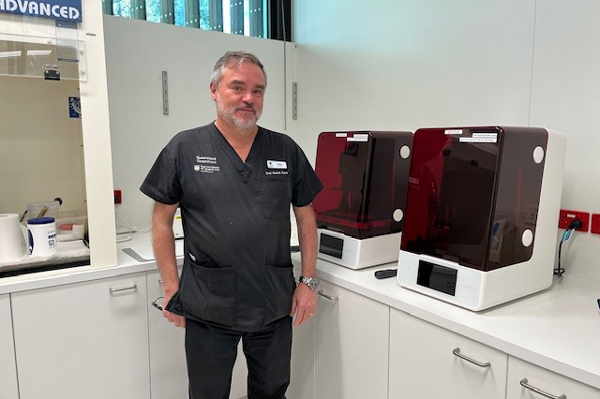
Oral Health Alliance (OHA) Director, Peter Reher with some of the new digitalisation initiative equipment.
The Oral Health Centre recently celebrated the first patient to receive dentures designed and manufactured as part of its digitalisation initiative.
For Peter Reher, Director of the Oral Health Alliance (OHA) partnership between The University of Queensland’s School of Dentistry and Metro North Health, this marks the culmination of over two years of planning and implementation.
“The aim of the OHA digitalisation initiative was to uplift the workflows in the Oral Health Centre by introducing intraoral scanners and 3D printers and milling equipment which replaces more traditional, labour-intensive methods,” Peter said.
“The intraoral scanners, for example, use small optical wands to capture 3D digital images of your teeth in minutes.
“The are used instead of the traditional dental impressions involving mouth trays filled with a putty-like paste.”
Mouth trays can be uncomfortable for patients, particularly those with a strong gag reflex and/or dental anxiety. Variables like air bubbles also mean that sometimes the impressions need to be redone.
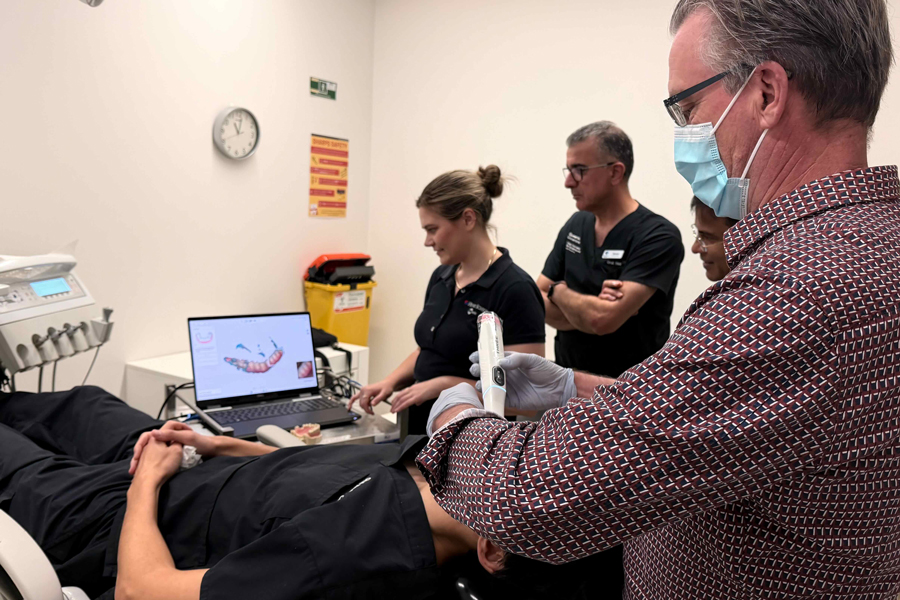
The new intraoral scanners provide many advantages for both patient and dentist.
“For patients, the intraoral scanner is quicker and more comfortable, allowing patients to breathe and swallow normally. The scanners also allow the patients to view the scan on screen which can assist in communication about their treatment,” Peter said.
“For the dentist, the scanner improves workflows and reduces the sterilisation involved in the traditional mouth trays, material costs and the need to store the completed models.”
The second initiative of the digitalisation is the introduction of 3D printers and dental milling machines, which allow crowns, bridges, dentures and prosthetic devices to be made on site.
“This brings with it a significant cost reduction. For example, a crown can be manufactured for around $50, compared to $400 previously. Manufacturing on site also means the items can be produced in a shorter time frame, with the images from the scanners being sent directly to the 3D printers/milling machine in the digital laboratory,” Peter said.
The digitalisation initiative means that patients will have access to the same technology that is used in private practice. In addition, The University of Queensland’s undergraduate and post-graduate dental health students will now have the opportunity to learn the latest technology in oral health, preparing them for future clinical environments.