
RBWH PET Service celebrates 20 years
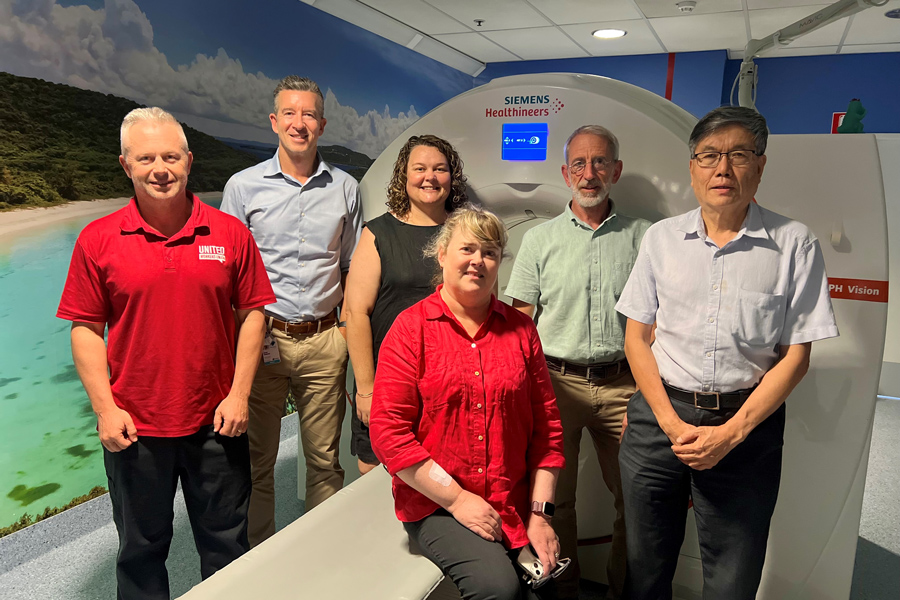
Pictured from left to right: Director Nuclear Medicine Technology Travis Pearson, Director Nuclear Medicine Dr David Pattison, Principal Radiochemist Melissa Latter, Director PET Technology / Assistant Director Nuclear Medicine Technology Louise Campbell, Principal Nuclear Medicine Medical Physicist Matthew Griffiths and Nuclear Medicine Staff Specialist Dr William Fong
This month, the Royal Brisbane and Women’s Hospital (RBWH) PET Service is celebrating 20 years of providing this vital medical imaging service to patients across Queensland and Northern New South Wales.
Established at RBWH in 2005, Specialised PET Services Queensland was the first public PET/CT scanner, cyclotron and PET radiopharmaceutical laboratory in the state.
Now, the highly skilled team consisting of nuclear medicine specialists, nuclear medicine scientists, radiopharmaceutical scientists, medical physicists, nursing and administration staff provide PET scans for approximately 25 patients per day at RBWH.
PET scans use radioactive tracers to create high resolution images of metabolic function in the body, providing information that structural scans like CT and MRI cannot. This technology is critical to detect and diagnose diseases such as cancer, inflammatory and brain disorders by identifying changes in how the body is working at a cellular level.
The team also manufactures PET radiopharmaceuticals as part of their PET manufacturing capability, Queensland – The Radiopharmaceutical Centre of Excellence (Q-TRaCE), which was the first public service in Australia to obtain Therapeutic Goods Administration (TGA) certification.
Q-TRaCE has developed 24 different PET radiopharmaceuticals since its inception with close to 10,000 patient doses manufactured on site and distributed across five Queensland Health hospitals each year to deliver this technology to public patients.
RBWH Director of Nuclear Medicine Dr David Pattison said the team were incredibly excited to reach this important milestone and to reflect on how far the service has come.
“Not only have we significantly grown the service, but we have also reduced the administered radiation dose to patients by one third over this time, delivering better outcomes for patients,” Dr Pattison said.
“Since our first scan in December 2005, we have performed almost 80,000 PET scans right here at RBWH, supporting clinicians to diagnose and treat patients more effectively.
“Our Q-TRaCE laboratory has manufactured radiopharmaceuticals for world-leading first-in-human PET research trials, and our imaging staff provide a one-stop-shop for patients who require PET and diagnostic CT scans at the same time.
“We’re also proud to have helped establish multiple new public PET services right across Queensland, including the Herston Imaging Research Facility (HIRF) in collaboration with research partners.”
RBWH PET Service patient Deanne Connolly has been a patient since 2007 after being diagnosed with neuroendocrine cancer, a cancer that starts in the hormone-making endocrine cells.
“I’ve been doing yearly PET scans at RBWH for the past 18 years to identify any changes to my cancer so I can receive appropriate treatment if required,” Deanne said.
“It’s always such a pleasure to go in and see the nuclear medicine team. It’s like going in to see family and I have such a special bond with them.
“The technology has improved a lot over the past 18 years and my scans are a lot easier and shorter these days.
“I wouldn’t be here today if it wasn’t for the nuclear medicine team.”
The service aims to continue to grow to meet Queensland’s future needs by increasing capacity to manufacture and distribute PET radiopharmaceuticals and exploring next generation technology such as Total Body PET/CT scanners to expand access to higher quality scans for more patients with lower radiation doses and faster scan times.