
Enhancing ICU rehabilitation through virtual reality
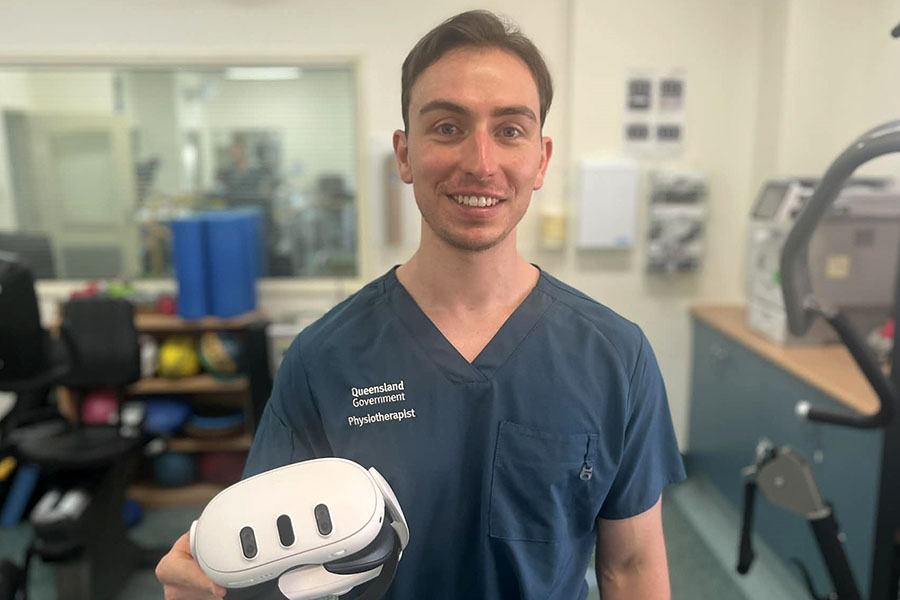
The Prince Charles Hospital Physiotherapist Kian Alexander
Can virtual reality help intensive care patients mobilise early? That’s the question researchers at The Prince Charles Hospital are asking to support patient recover.
Early mobilisation and rehabilitation are critical components of recovery for patients in an Intensive Care Unit (ICU).
However, delivering meaningful and engaging exercise in this setting remains a persistent challenge. Patients are often limited by fatigue, illness severity and reduced motivation, which can impact both participation and outcomes.
Research led by The Prince Charles Hospital (TPCH) physiotherapist Kian Alexander is exploring whether virtual reality (VR) can be used as a novel adjunct to standard in-bed cycling. In‑bed cycling involves attaching specialised equipment to a patient’s hospital bed, allowing them to undertake gentle leg exercise while remaining in the ICU.
Mr Alexander’s investigator-initiated study aims to improve patient engagement and optimise rehabilitation outcomes during critical illness.
“By simulating real-world environments—such as cycling through scenic landscapes—VR appears to shift the focus away from the physical strain of exercise, helping patients remain engaged for longer periods,” Mr Alexander said.
“Early feedback from study participants has been overwhelmingly positive, with many reporting that the VR experience makes exercise more enjoyable and immersive.”
The primary focus of the study remains on patient-centred outcomes, including exercise performance, physiological responses and perceived exertion.
“Importantly, this work seeks to address a key barrier in ICU rehabilitation – not just whether patients can exercise, but whether they are motivated to do so,” Mr Alexander said.
“Enhancing the enjoyment of rehabilitation may play a crucial role in increasing participation and, ultimately, improving recovery trajectories.”
As recruitment continues, Mr Alexander is optimistic that this approach may offer a simple, scalable way to enhance rehabilitation for critically ill populations.
“By integrating technology with established physiotherapy practices, this study aims to redefine how exercise is delivered in the ICU – making it not only effective, but also engaging and meaningful for patients at a vulnerable stage of their recovery,” he said.
Mr Alexander also acknowledged the support of The Prince Charles Hospital Foundation (TPCHF), noting that a New Investigator Grant had been instrumental in progressing the study.
“The funding has enabled the provision of VR headsets, ensuring consistent and reliable delivery of the intervention,” he said.
“Just as importantly, the TPCHF New Investigator Grant has provided protected time away from a full clinical caseload, allowing focused efforts on patient recruitment, data collection and overall study coordination—an invaluable resource in a busy ICU environment.”