
New AI tools for emergency triaging could fast-track access urgent care for patients
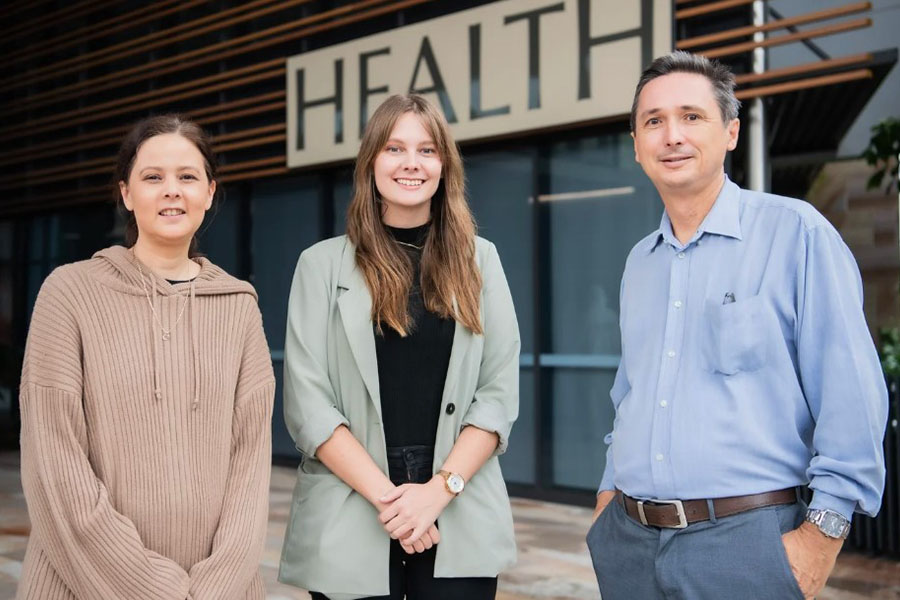
(left to right): Dr Candice Bowman, Carly Hudson and Professor Marcus Randall from Bond University.
Researchers are developing a new machine learning tool to support emergency department triage.
Data scientists from the Critical Care Research Group and Bond University hope the tool will analyse patients’ triage notes and cross-reference them with thousands of others, to pick up patterns and make recommendations to help doctors fast track urgent care or further assessment.
Bond University Professor Marcus Randall said the model would be developed using data from The Prince Charles Hospital (TPCH) Emergency Department.
“It’s an incredibly busy and stressful environment and clinicians have to make critical decisions quickly and repeatedly,” Prof Randall said.
“We should never rely on machines to decide patient treatment, but we can get them to interpret vast amounts of data to make predictions that a human can’t.
“We hope this new tool will improve existing methods of examining triage notes, which can often be difficult to understand.
From 2022-2023, the Australian Institute of Health and Welfare reported 68,062 mental health-related presentations to emergency departments in Queensland, with a single-day peak of 254 presentations.
Prof Randall, Dr Candice Bowman and Carly Hudson received a grant from the Queensland Mental Health Commission for the project.
“It might predict an immediate risk, based on the patient’s history and suggest they be kept for future monitoring, or it might show that this person can go home but needs community monitoring or a follow-up phone call the next day,” Prof Randall said.
“The aim is to provide EDs with a supportive tool to make sure that everyone who really needs care based on their history, gets it.
“Hopefully our prototype system can be developed into something that is incorporated into routine practice.”
CCRG’s Clinician Research Lead Dr Oystein Tronstad said the project would build on the group’s existing collaborative projects aimed at AI innovation in emergency departments, as well as intensive care units.
“As part of CCRG’s ongoing commitment to impactful clinical research, we’re proud to be working in collaboration with Bond University and TPCH’s Emergency Department on this innovative project,” Dr Tronstad said.
CCRG Research Fellow Adrian Goldsworthy said the project had the potential to streamline access to care for patients in urgent need of mental health assessment.
“While we agree AI and machine learning will never replace human-delivered care, AI and humans can provide efficiencies that the healthcare system, and most importantly patients can immediately benefit from,” Adrian said.
According to the Australian Institute of Health and Welfare, 3,249 Australians took their own life in 2022.
In the first half of 2023, Queensland had the highest average monthly rate of ambulance attendances for suicidal ideation and the highest average monthly rate of ambulance attendances for suicide attempt.
If you or anyone you know needs assistance, support is available. The Lifeline hotline is 13 11 14 (text 0477 13 11 14) or Beyond Blue on 1300 224 636.