
Co-creating virtual environments with patients to prepare for home after brain injury
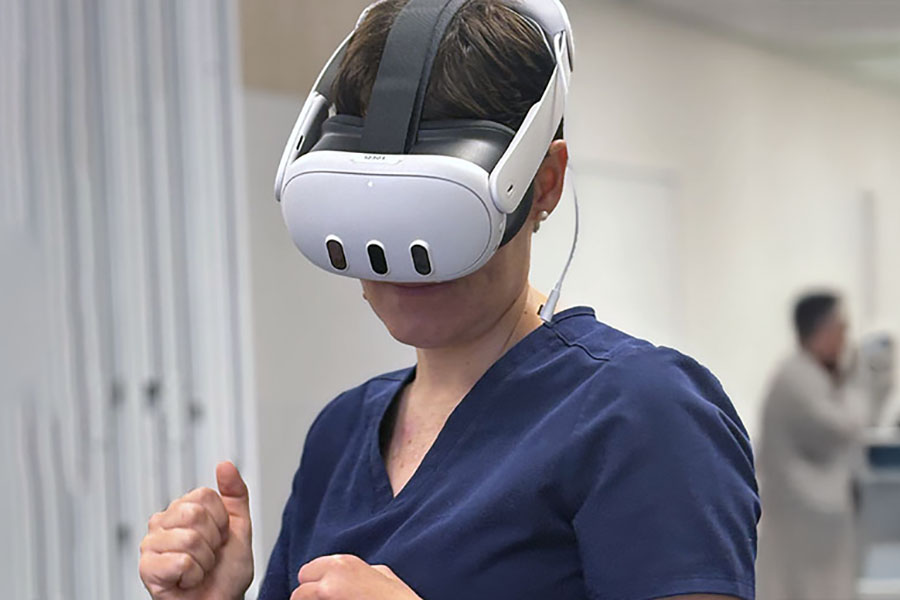
Clinician testing the virtual reality scenarios with a virtual reality headset
Researchers at STARS are investigating the benefits of immersive virtual reality in assessing patients with traumatic brain injury (TBI).
TBI can impact a person’s cognitive skills including memory and attention, communication, physical abilities and self-awareness. STARS Brain Injury Rehabilitation Unit (BIRU) provides rehabilitation to patients with acquired brain injuries, including those with TBI.
Dr Emmah Doig, STARS Education and Research Alliance (SERA) Conjoint Senior Research Fellow Occupational Therapy, is investigating the use of immersive virtual reality (VR) as a potential solution for the challenge of assessing someone with TBI’s abilities while in hospital rehabilitation.
“When people are in a hospital setting there is no opportunity for them to experience everyday activities people do at home or in the community, such as going shopping or taking a train or bus,” Dr Doig said.
“Practising activities in a simulated environment using VR could help patients feel more prepared for when they leave hospital. In addition, the use of VR can provide video feedback which is particularly useful in improving self-awareness in people with TBI.”
Currently, the development of VR scenarios for use in clinical settings is limited, especially those that have been co-designed with people with TBI and their clinicians.
“The aim of the project was to co-design, develop and test a VR-based intervention to increase confidence and preparedness for home after brain injury,” Dr Doig said.
The co-design team includes STARS clinicians and consumers with lived experience of TBI or caring for a person with TBI, SERA researchers and VR developers.
“As well as co-designing a home and transport simulation, a facilitator application was designed in conjunction with a tutorial to enable people with TBI to learn how to use immersive VR,” Dr Doig said.
“The next step will to be to assess the feasibility of the co-designed VR-based intervention at STARS with STARS patients throughout 2026.”
The research team includes Jennifer Muller (Consumer and Community Involvement) and a wider team of researchers and clinicians across STARS, Metro North, RECOVER and The University of Queensland.