Compassionate Care Principles
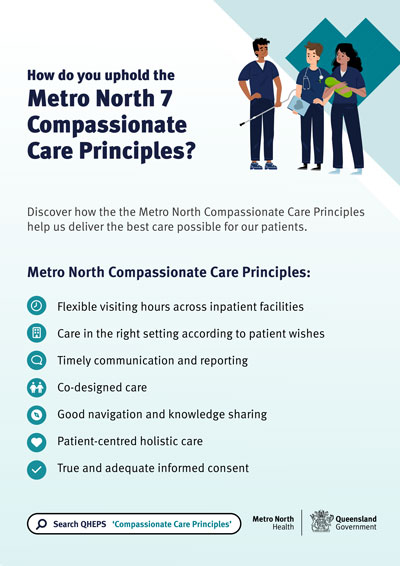 The Metro North Compassionate Care Principles was released across Metro North Health in March 2023 and were developed to represent the voice of consumers, family members and carers in relation to their experiences in receiving care in Metro North Health.
The purpose of the principles is to promote engagement and inclusion with our patients, families and carers in decision making and communication leading to improved satisfaction. The principles also represent how we can improve access, usability and advance the design of our services based on what patients need.
The Principles align with the National Safety and Quality Health Service Standards and the Metro North Values in Action providing a consistent message about the level of care and behaviours that consumers can expect from Metro North Health staff.
Francesca’s story – Timely Communication and Reporting
This video shares a real-life story from a staff member as a consumer of care, highlighting the Compassionate Care Principle of Timely Communication and Reporting. It’s a powerful reminder that simple actions such as truly listening and responding are fundamental to delivering safe, person‑centred
and high‑quality care.
Kyles story – Compassionate Care Principles
In this video, Kyle’s parents courageously share their reflections on their son’s care and the experience their family encountered. Their story invites us to pause and consider how each of the seven Compassionate Care Principles — from communication and consent to co‑designed, patient‑centred
care — shapes the experience of both patients and families. Though confronting, Kyle’s story invites reflection, learning, and a renewed commitment to show up with compassionate and human‑centred care in every moment that matters.
Jane’s story – Good Navigation and Knowledge Sharing
This video shares the lived experience of Jane, an ICU survivor, bringing the Compassionate Care Principle of Good Navigation and Knowledge Sharing to life. Her story highlights how clear communication, accessible information, and coordinated support can make a lasting difference for patients and families during recovery and beyond. Her story reminds us of the importance of walking alongside patients and families with clarity, compassion, and care during their most vulnerable moments.
Compassionate Care – Co-designed Care – Kidney Health Services
This video showcases the power of co‑designed care. By working in genuine partnership, young consumers and clinicians shaped care that reflects lived experience, strengthens relationships, and improves outcomes. It’s a clear example of compassionate care achieved by designing services with those
we serve.
Compassionate Care Principles – True and Adequate Informed Consent – Child Life Therapist
This video highlights the principle of True and Adequate Informed Consent, using paediatric care to illustrate practices that apply to all clinicians and patients. It shows how clear communication, emotional support, and genuine engagement build trust, reduce distress, and reinforce that informed consent
is an important human connection—not a transaction.
Resources
To order pull up banners, please contact the design team at metronorth-design@health.qld.gov.au
Podcasts
- Five Things About Culturally Informed Compassion With Roslyn Boland – 5 Things Nursing Podcast by RBWH (Ep 87) | Podcast on Spotify
- Five Things About Self Compassion – A Lived Experience with Nick Coriat – 5 Things Nursing Podcast by RBWH (Ep 93) | Podcast on Spotify
Panel discussions
- Metro North Speaker Series – Finding purpose and compassion in healthcare
- The Power of Compassion – A Panel Discussion
Interview questions
Examples of Values / Behaviour based questions to help assess candidates’ alignment with Metro North Values.
Signature block
Compassionate Care Principles signature banner available through the Metro North email signature generator
PowerPoint template
Contact Us
Belinda Faulkner
Nursing Director, CSDS
belinda.faulkner@health.qld.gov.au